Python String Functions With Examples:
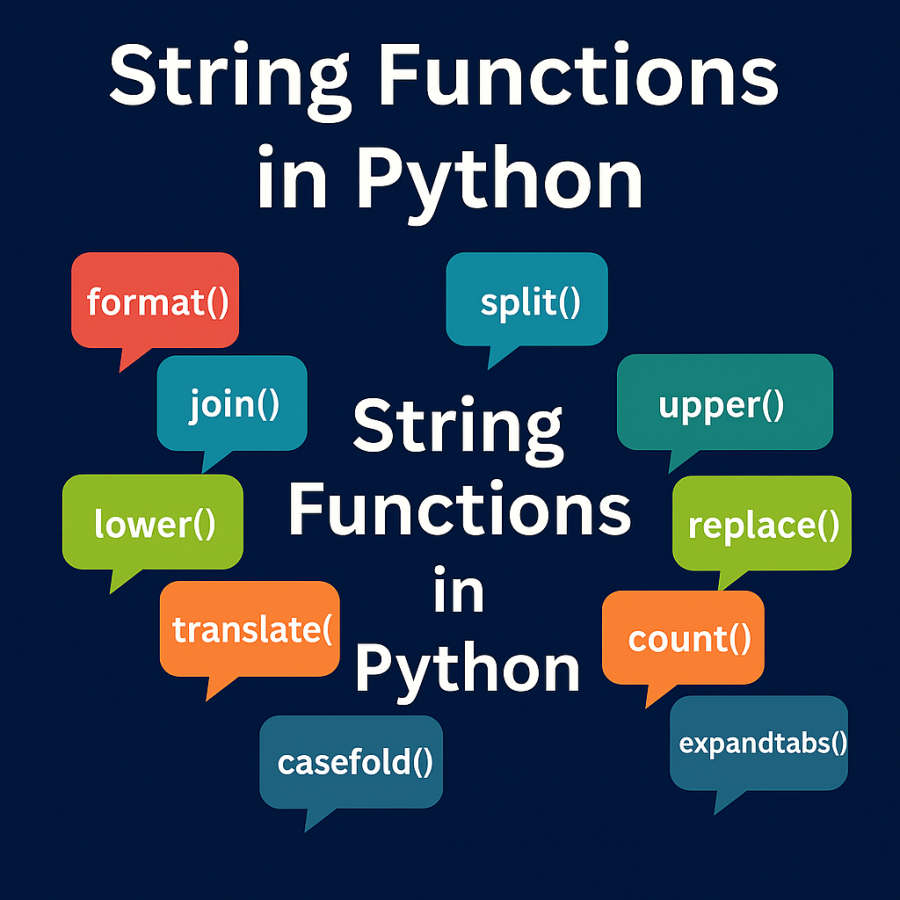
String handling is one of the most important parts of Python programming. Using the right Python string functions, you can easily modify, format, and analyze text data for any type of project.
Introduction
Strings are one of the most important data types in Python. They are used to store and manipulate text. Whether you are developing a simple script or working on a large project, string manipulation is essential.
Python provides several built-in string functions to make working with text easier, faster, and more efficient. In this guide, we will explore the 10 most useful Python string functions with examples that you can use in your projects.
1. len() – Get the Length of a String
The len() function returns the total number of characters in a string, including spaces.
Syntax:
len(string)
Example:
text = “Python is fun”
print(len(text)) # Output: 13
2. upper() – Convert to Uppercase
This method converts all characters of a string to uppercase.
Syntax:
string.upper()
Example:
name = “python”
print(name.upper()) # Output: PYTHON
3. lower() – Convert to Lowercase
This method converts all characters to lowercase.
Syntax:
string.lower()
Example:
name = “PYTHON”
print(name.lower()) # Output: python
4. strip() – Remove Leading and Trailing Spaces
It removes spaces (or specific characters) from the start and end of a string.
Syntax:
string.strip()
Example:
text = ” Python ”
print(text.strip()) # Output: Python
5. replace() – Replace Substring
Replaces all occurrences of a substring with another substring.
Syntax:
string.replace(old, new)
Example:
text = “I love Java”
print(text.replace(“Java”, “Python”)) # Output: I love Python
6. split() – Split String into List
Breaks a string into a list based on a separator (default is space).
Syntax:
string.split(separator)
Example:
text = “Python is fun”
print(text.split()) # Output: [‘Python’, ‘is’, ‘fun’]
7. join() – Join List into String
Joins elements of a list into a single string.
Syntax:
separator.join(iterable)
Example:
words = [“Python”, “is”, “fun”]
print(” “.join(words)) # Output: Python is fun
8. find() – Find Substring Position
Returns the index of the first occurrence of a substring (or -1 if not found).
Syntax:
string.find(substring)
Example:
text = “Python programming”
print(text.find(“programming”)) # Output: 7
9. count() – Count Occurrences
Counts how many times a substring appears in a string.
Syntax:
string.count(substring)
Example:
text = “banana”
print(text.count(“a”)) # Output: 3
10. capitalize() – Capitalize First Letter
Converts the first character of a string to uppercase and the rest to lowercase.
Syntax:
string.capitalize()
Example:
text = “python is amazing”
print(text.capitalize()) # Output: Python is amazing
Real-Life Uses of Python String Functions
Data Cleaning: Removing spaces, fixing cases (strip(), lower()).
Text Analysis: Counting words, finding keywords (count(), find()).
User Input Formatting: Standardizing text (capitalize(), upper()).
Data Conversion: Joining and splitting text for data processing (join(), split()).
Additional Useful String Functions
Apart from the above, Python provides many more methods:
islower() → Checks if all characters are lowercase.
isupper() → Checks if all characters are uppercase.
title() → Converts first letter of each word to uppercase.
count() → Counts the number of occurrences of a substring.
Example:
text = “banana”
print(text.count(“a”)) # Output: 3
Best Practices for Using String Functions
Always use strip() before validating inputs to avoid space errors.
Use lower() or upper() when comparing strings to avoid case sensitivity issues.
For large text processing, consider using split() with a limit to improve performance.
Summary Table of Python String Functions
Function Description Example Output
len() Returns length of string 6
upper() Converts to uppercase HELLO
lower() Converts to lowercase hello
strip() Removes spaces Hello
replace() Replaces substring I like Python
split() Splits string into list [‘a’,’b’]
find() Finds index of substring 7
startswith() Checks start of string True
endswith() Checks end of string True
format() Formats text My name is…
Conclusion
Mastering Python string functions will make your coding life easier. These built-in methods help you manipulate text efficiently, whether for cleaning data, formatting output, or building complex programs.
By practicing these functions with real examples, you can handle almost any text-related task in Python.
SEO Keywords to Use in Meta & Content:
Python string functions, Python string methods with examples, Python text manipulation, learn Python strings, Python programming basics.
want to learn about Debugging techinques Click here